Parsec Enabled TLS Demo on Safety Island Communication/HIPC - Baremetal Stock Image
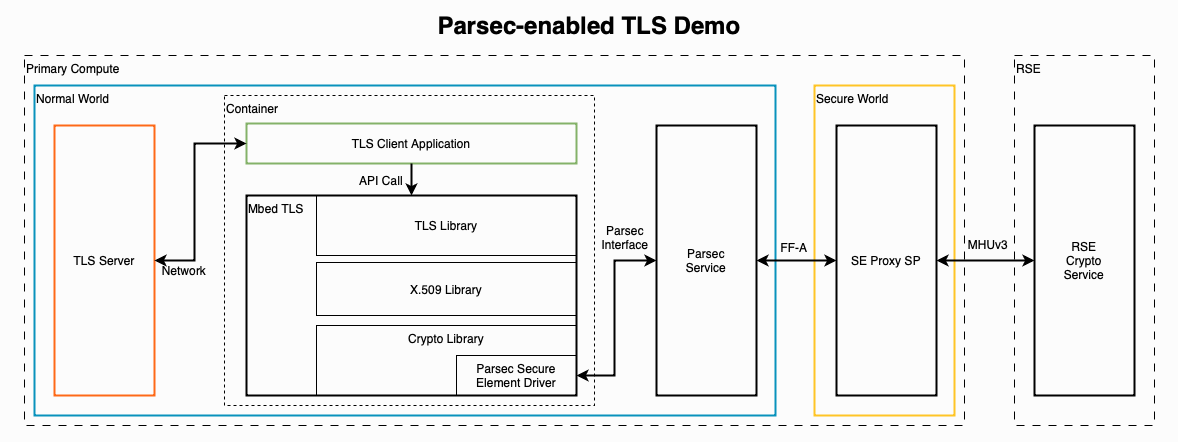
The Parsec-enabled TLS Demo demonstrates secure TLS communication, with cryptographic tasks distributed between user-space software (the TLS client, Mbed TLS libraries) and the secure capabilities (RSE Crypto Service) exposed by the Safety Island Communication/HIPC Baremetal stock firmware image. For more details on the Parsec-enabled TLS demo, refer to the Arm documentation.
Run the Parsec Enabled TLS Demo
Based on Arm's documentation here.
-
Create a virtual RD-1AE board running the
Safety Island Communication/HIPC (Baremetal) (1.1.1)firmware image. For further details, please refer to the RD-1AE Quickstart guide. -
When the device boots, navigate to the Console tab and select
Primary Compute Non-Securefrom the console selector dropdown. -
Log in as root.
fvp-rd-kronos login: rootroot@fvp-rd-kronos:~# -
Check if all the expected services have been initialized:
root@fvp-rd-kronos:~# systemctl is-system-running --waitrunning -
Start the
ssl_serverfrom the Primary Compute terminal in the background, you should see a similar output:root@fvp-rd-kronos:~# ssl_server &[1] 483root@fvp-rd-kronos:~# . Seeding the random number generator... ok. Loading the server cert. and key... ok. Bind on https://localhost:4433/ ... ok. Setting up the SSL data.... ok. Waiting for a remote connection ...The TLS client application can take an optional parameter as the TLS server IP address. The default value of the parameter is localhost.
-
Run
ssl_client1from the Primary Compute terminal in a container:root@fvp-rd-kronos:~# docker run --rm -v /run/parsec/parsec.sock:/run/parsec/parsec.sock -v /usr/bin/ssl_client1:/usr/bin/ssl_client1 --network host docker.io/library/ubuntu:22.04 ssl_client1Trying to pull docker.io/library/ubuntu:22.04...Getting image source signaturesCopying blob a186900671ab done |Copying config 981912c48e done |Writing manifest to image destination. Seeding the random number generator... ok. Loading the CA root certificate ... ok (0 skipped). Connecting to tcp/localhost/4433... ok. Setting up the SSL/TLS structure... ok. Performing the SSL/TLS handshake... ok. Performing the SSL/TLS handshake... ok< Read from client: 18 bytes readGET / HTTP/1.0> Write to client: 156 bytes writtenHTTP/1.0 200 OKContent-Type: text/h tml<h2>Mbed TLS Test Server</h2>ok. Verifying peer X.509 certificate... ok> Write to server: 18 bytes writtenGET / HTTP/1.0< Read from server:<p>Successful connection using: TLS-ECDHE-RSA-WITH-CHACHA20-POLY1305-SHA256</p>. Closing the connection... ok. Waiting for a remote connection ... 156 bytes readHTTP/1.0 200 OKContent-Type: text/html<h2>Mbed TLS Test Server</h2><p>Successful connection using: TLS-ECDHE-RSA-WITH-CHACHA20-POLY1305-SHA256</p> -
Stop the TLS server and synchronize the container image to the persistent storage:
root@fvp-rd-kronos:~# pkill ssl_server[1]+ Terminated ssl_serverroot@fvp-rd-kronos:~# sync -
Perform a software-initated shutdown:
root@fvp-rd-kronos:~# shutdown now